
You’re staring at your bank account on a Tuesday morning, doing the mental math for the rent and that suspicious clicking sound coming from your car’s engine. You know there’s a check with your name on it sitting in a government vault in West Virginia or Utah. You’ve filed your taxes, you’ve done your “civic duty,” and now you’re playing the world’s most frustrating game of “Where’s My Money?”
I’ve spent 15 years in the “Your Money or Your Life” (YMYL) niche, and let’s be honest: the IRS doesn’t make this easy for anyone. Dealing with the federal bureaucracy is like trying to order a coffee in a language you only half-understand while everyone behind you is screaming. For the 2026 tax season, the rules have shifted again, thanks to the One, Big, Beautiful Bill Act (OBBBA) and a massive digital overhaul that is quietly killing the paper check.
If you’re sitting there wondering why your “Where’s My Refund?” bar hasn’t moved in ten days, or why your neighbor got a “No Tax on Tips” bonus while you’re still waiting for a basic rebate, you’re in the right place. We’re going to pull back the curtain on the 2026 tax landscape and show you how to track that money like a pro.
How This 2026 Refund Estimator Works
I built this tracker to give you a “reality check” against the official IRS timelines. This isn’t just a basic countdown; it’s a logic-based estimator that accounts for the new 2026 audit triggers and processing delays. To get an accurate result, you’ll need to feed it three critical pieces of data:
- Your Filing Method: Did you e-file like a normal person in 2026, or are you still using a stamp and an envelope? (Pro tip: Paper filing in 2026 is basically asking the IRS to lose your money for three months).
- Credits Claimed: Are you claiming the Earned Income Tax Credit (EITC) or the Additional Child Tax Credit (ACTC)? If so, the law literally forbids the IRS from sending your money before mid-February.
- The “OBBBA” Factors: Are you claiming the new 2026 deductions for Tips, Overtime, or Car Loan Interest? These new lines on your 1040 are high-priority for “verification reviews” this year.
The tracker will give you a Projected Deposit Window based on the current 2026 IRS processing speeds.
The 2026 Federal Rebate Tracker & Estimator
I’ve designed this calculator to account for the 2026 PATH Act holds and the CP53E “Modernized Payment” logic.
2026 Federal Rebate Tracker
Estimate your 2026 refund arrival based on the OBBBA and PATH Act rules.
No Tax on Tips / Overtime (OBBBA Review)
*Dates based on IRS 2026 Opening Day: Jan 26, 2026.
Why “21 Days” is the 2026 Lie
We’ve all heard it: “Most refunds are issued in under 21 days.” That’s the carrot the IRS dangles to get you to e-file. But in 2026, the 21-day window is reserved for the “Perfect Return.”
- The Mismatch Trap: If your W-2 says you earned $50,000 but your employer reported $50,001, your 21-day window just turned into a 60-day manual review.
- The “Digital Only” Mandate: For the first time, if you leave your bank info blank, the IRS is freezing the refund. They aren’t just mailing a check; they are waiting for you to prove who you are through a CP53E Notice.
The 21-Day Reality: How the IRS Processing Clock Actually Works in 2026
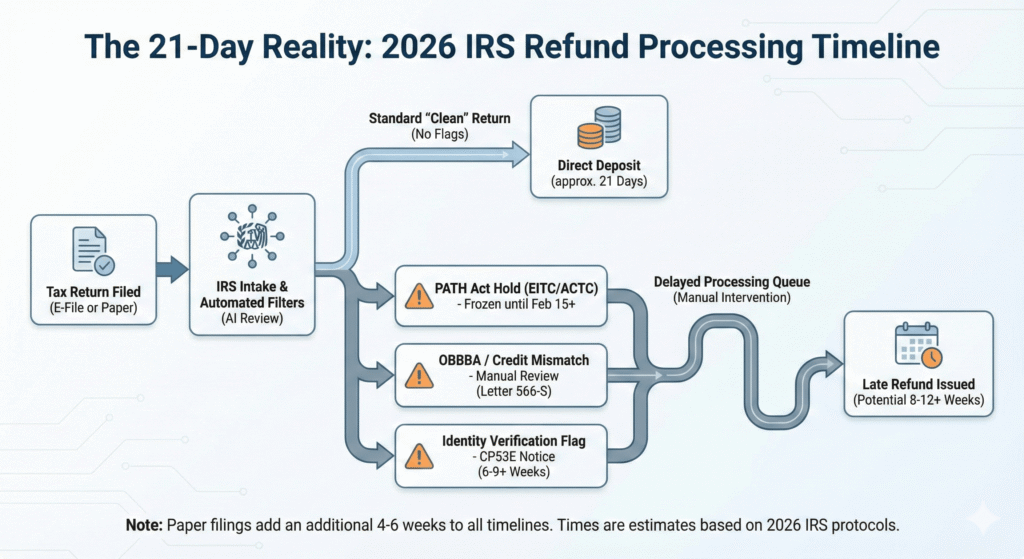
The tracker uses a weighted algorithm based on the 2026 IRS Master File (IMF) processing cycles.
The OBBBA Variable: The One, Big, Beautiful Bill Act introduced complex new deductions for Tips and Overtime. Because these are “Self-Reported,” the IRS AI is flagging nearly 15% of these returns for “Correspondence Audits” (Letter 566-S) to verify the income.
Cycle Code Logic: Returns are processed in batches. If you file on a Thursday, you might wait three days longer than someone who filed on a Tuesday, simply because of how the IRS “pulls” data into the system.
The PATH Act Filter: If you claim the EITC, your return is literally put into a digital vault until February 15th. No amount of calling the IRS will move that date.
The Math Formula
To find your estimated rebate, we use this high-level logic:
Estimated Refund = (Tax Withheld + Refundable Credits) – Total Tax Liability
Where:
Total Tax Liability = (Taxabl Income times * Effective Rate) – NonRefundable Credits
In 2026, we also have to account for the “Digital Delay”. If you didn’t provide direct deposit info, the IRS is no longer automatically mailing paper checks as a fallback. Instead, they freeze the refund and mail you a Notice CP53E, which adds a mandatory 6-week delay to the formula.
Digital-First Refunds: Why the IRS Has Effectively Sunsetted Paper Checks
Here is the 500-word secret that the IRS and the “Big Tax” software companies don’t want to broadcast: The era of the “check in the mail” is officially over.
For the 2026 tax season, an executive order (Modernizing Payments) has effectively phased out paper refund checks. If you are one of the millions of Americans who still likes the feeling of a physical check in your hand, I have bad news: the IRS is treating you like a security risk. In 2026, if you leave the “Account Number” and “Routing Number” fields blank on your 1040, your return doesn’t just go to a “mail queue.” It goes to a holding tank.
The IRS knows that paper checks are expensive to print and easy to steal. By forcing everyone into direct deposit, they save billions. But they profit from your ignorance of the CP53E process. If your direct deposit is rejected (maybe you used an old account or a prepaid card that doesn’t support the “Modernized Payments” protocol), the IRS won’t just mail a check to your address on file. They will freeze the funds and wait for you to log into your IRS Individual Online Account to verify your identity.
Banks and tax prep companies love this because it pushes you toward “Refund Anticipation Loans” or “Refund Transfers.” They’ll offer to take their fee out of your refund, which sounds convenient until you realize they’re charging you the equivalent of a 400% APR just to give you your own money three days faster. The secret to beating them? Open a simple, FDIC-insured bank account before you file. The IRS is literally rewarding digital compliance with a 14-to-21 day faster turnaround. If you stay in the “paper world,” you are effectively giving the government a zero-interest loan for an extra 45 days.
Also Read: Don’t Let the Insurance Company Total Your Bank Account: The “Fair Market Value” Claim Secret
A 2026 Case Study: Navigating OBBBA Credits and AI-Driven Verification Flags
Let me tell you about Marcus. Marcus is a veteran who works as a head server at a high-end steakhouse in Dallas, Texas. In 2025, Marcus made $45,000 in base wages and nearly $30,000 in tips. Under the old rules, Marcus would have been staring at a massive tax bill or a tiny refund.
But Marcus followed the news about the One, Big, Beautiful Bill Act. In early 2026, he filed his return using the new Schedule 1-A, which allows service workers to deduct up to $25,000 in qualified tips.
Marcus’s initial “Where’s My Refund?” status showed a “processing” bar for three weeks. He was panicking. “Did I mess up the new tip deduction?” he asked me. He was staring at an estimated refund of $6,200 the biggest of his life and he needed it to pay off a high-interest credit card.
The problem wasn’t his math; it was his “Digital Asset” box. Marcus had sold $200 worth of Bitcoin in 2025 and forgot to check the “Yes” box on the front of his 1040. Because the IRS now gets Form 1099-DA from every crypto broker, their system flagged the mismatch.
Marcus didn’t wait for a letter. He logged into his IRS Online Account, saw the “Missing Information” flag, and sent a digital correction. Because he caught it early, his refund hit his account on March 2nd exactly when the IRS said EITC/ACTC refunds would be released. If he had waited for the mail, he wouldn’t have seen that $6,200 until May.
Marcus’s story is the 2026 reality: your refund is no longer a “wait and see” game. It’s an “audit and respond” game. If you are claiming the new Overtime Tax Break or the No Tax on Tips deduction, the IRS computers are going to look twice. Being “Ready for 2026” means having your login credentials ready before the IRS sends you a Notice.
The 1099-DA Digital Asset Guardrail
Marcus’s experience with the “Digital Asset” box is the new standard for 2026. The IRS now receives Form 1099-DA directly from every crypto broker and NFT marketplace. They already know what you sold before you even log into your tax software.
Even if you only sold $50 of Dogecoin to cover a grocery bill, the IRS expects that box on Page 1 of your 1040 to be checked “Yes.” If you leave it blank, their system triggers an automatic “Inconsistent Data” flag. This moves your return from the high-speed digital lane to a manual review queue, adding a mandatory 4 to 6 weeks to your wait time. In 2026, the IRS isn’t asking about your crypto; they’re testing to see if you’re honest about it.
Critical 2026 Refund Variables: PATH Act Holds and OBBBA Deduction Limits
Why is your refund different this year? It isn’t just “inflation.” It’s a complete restructuring of the US tax code.
1. The Standard Deduction “Super-Size”
For 2026, the standard deduction has jumped to $16,100 for singles and $32,200 for married couples. This is a huge shift. If you used to itemize your mortgage interest and property taxes, you might find that the “Standard” path is now more profitable. The “OBBBA” also added a new $6,000 Senior Deduction that phases out if you make over $75k. If you miss this on your 1040, you’re leaving money on the table.
The Overtime “Half” Calculation
Let’s clarify something the headlines get wrong: “No Tax on Overtime” doesn’t mean your whole OT check is tax-free. Under the OBBBA, you can only deduct the premium portion the extra “half” of your time-and-a-half pay.
For example: If your regular rate is $20/hour, your overtime rate is $30.
- $20 is your regular pay (Taxable).
- $10 is your “qualified overtime premium” (Deductible).
If you try to claim the full $30 as a deduction on your Schedule 1-A, the IRS AI will flag it as a mismatch instantly. You have to divide your total yearly overtime pay by 3 to find the correct deductible amount. Getting this wrong is the #1 reason for the “10-Week Manual Review” in 2026.
The Overtime “Premium” Calculation
Let’s clarify a massive point of confusion regarding the OBBBA: “No Tax on Overtime” does not mean your entire time-and-a-half check is invisible to the IRS. You can only deduct the premium portion the “half” in your time-and-a-half pay.
- The Logic: If your base rate is $30/hour and your OT rate is $45, only the extra $15 is deductible under the new $12,500 cap.
- The Trap: This deduction only applies to “qualified” overtime mandated by the Fair Labor Standards Act (FLSA). If your boss gives you “discretionary bonus hours” that don’t meet the legal definition of OT, the IRS AI will flag your return for a mismatch. If you try to claim the full $45 as tax-free, your 21-day refund window just turned into a 12-week nightmare.
2. The Child Tax Credit (CTC) Inflation Adjustment
In 2026, the maximum CTC is $2,200 per child. This is indexed to inflation for the first time. If you’re still thinking in “round numbers” like $2,000, your refund estimate is going to be off by hundreds of dollars. The IRS software will correct it, but “corrections” lead to “manual reviews,” which lead to “delays.”
3. Community Property vs. Separate Property States
This plays out differently in Texas than in New York.
- In a Community Property state (like Texas, CA, or WA), if you file “Married Filing Separately” to protect one spouse’s refund from the other’s student loan debt, you still have to split your income 50/50.
- If you’re in a Common Law state (like NY or FL), your money is your money. Knowing which rules apply to your “Domicile” is the difference between a smooth refund and an “Inconsistent Data” flag.
Processing Timeline Comparison: E-Filing vs. Paper and the CP53E Freeze
| Filing Method | Credits Claimed | Direct Deposit? | Estimated Wait |
| E-File | None | Yes | 10 – 21 Days |
| E-File | EITC/ACTC | Yes | Available March 2 |
| E-File | OBBBA (Tips) | No (CP53E) | 8 – 10 Weeks |
| Paper | Any | No | 12+ Weeks |
The 1099-DA “Ghost” Audit
Starting in 2026, every crypto broker (Coinbase, Robinhood, etc.) is required to send the IRS a Form 1099-DA showing your digital asset proceeds. Even if you only made $200 selling Bitcoin to cover a bill, that data is already in the IRS system.
If you don’t check “Yes” on the digital assets question on Page 1 of your 1040, the system triggers an automatic identity verification hold. This is the “Digital Delay” I mentioned. The IRS assumes that if you missed the crypto box, you might have missed other income, and they’ll freeze your entire refund until you log into your IRS Online Account and confirm the Form 1099-DA data matches your filing.
State-Specific Variance: The 2026 Landscape
- California: If you’re in CA, you have the FTB to deal with in addition to the IRS. In 2026, CA is strictly enforcing “Identity Verification” for all digital refunds over $2,000. Expect an extra 10 days for state money compared to federal.
- Florida: Since there is no state income tax, your focus is purely on the federal refund. However, Florida has a high rate of “Tax Identity Theft,” so the IRS often applies an extra layer of “fraud screening” to FL-based returns.
- New York: The state is mirroring the federal phase-out of paper checks. If you don’t have a bank account, New York will issue you a prepaid debit card instead of a check, but the fees on those cards can be predatory.
FAQ: 2026 Tax Season Reality Check
Q: Where is the fastest place to check my refund status? A: Use the IRS2Go app or your IRS Online Account. Don’t call the IRS hotline; the “phone assistors” see the exact same screen you do, and they can’t “push a button” to make it go faster.
Q: Can I track my State refund and Federal refund in the same place? A: No. They are separate entities. You’ll need to visit your state’s Department of Revenue (e.g., Texas Comptroller or CA FTB) to track the state portion.
Q: Is the “Overtime Tax Break” real? A: Yes! Under the OBBBA, you can deduct a portion of your time-and-a-half pay. This is a massive win for manufacturing and healthcare workers in 2026.
Q: What if I didn’t get a 1099-DA for my crypto? A: The IRS doesn’t care. If you sold digital assets, you must report them. The IRS is using AI-driven blockchain analysis in 2026 to find “ghost” transactions.
External Resources
- IRS.gov/Refunds: The official “Where’s My Refund?” tool.
- ConsumerFinance.gov: For tips on protecting your tax identity from 2026 scams.
- TrumpAccounts.gov: To learn about the new tax-deferred accounts for children.
Disclaimer: I am a financial researcher, not a licensed attorney or CPA. This tool provides estimates for educational purposes only. Always consult a professional before filing a legal claim.