

You’re sitting in the corner of your living room, the glow of your dual monitors illuminating a pile of laundry that hasn’t been folded in three days. You’re self-employed, which sounds glamorous in a LinkedIn bio, but right now it just feels like you’re paying for your own coffee, your own health insurance, and crucially every single square inch of the floor you’re standing on. You just got your quarterly tax bill, and it’s enough to make you want to go back to a cubicle.
Let’s be honest, the IRS doesn’t make being your own boss easy. They see your home office and think “personal luxury,” while you see it as the “engine room” of your life. I’ve spent 15 years in the “Your Money or Your Life” trenches, and if there’s one thing I’ve learned, it’s that most self-employed folks leave thousands of dollars on the table because they’re too scared of an audit to claim what they actually deserve. We’re going to change that. Grab a coffee, and let’s talk about how to turn that spare bedroom into a tax-shielding fortress.
The 2026 Self-Employed Deduction Estimator
This tool calculates your potential savings using the latest OBBBA and Section 179 rules.
Self-Employed Expense Estimator
Estimate your 2026 Home Office & Gear Deductions.
How This Deduction Estimator Works
I built this calculator to help you stop guessing and start claiming. Most people think “home office” is just a random number you pull out of thin air, but the IRS wants precision. To get a number that won’t make an auditor blink, you need three main inputs:
- Square Footage of Your Workspace: This isn’t your whole house. It’s the area used only for work. Measure the room (or that specific corner) precisely.
- Total Home Expenses: If you’re doing the “Actual Expenses” method, you’ll need your annual totals for rent/mortgage interest, utilities, and insurance.
- New Equipment Costs: Did you buy a new MacBook, a standing desk, or a fancy ergonomic chair this year? We’re going to look at how to write those off immediately using Section 179.
The calculator will output two numbers: your deduction using the Simplified Method and your estimate using the Actual Expense Method.
Home Office Logic: Simplified vs. Actual Expense Methods in 2026
The IRS gives you two paths. Path A is the “Simplified Method,” which is essentially the IRS saying, “We don’t want to see your receipts, just give us the square footage.” Path B is the “Actual Expense Method,” which is for people with high rent or massive utility bills who are willing to do the paperwork for a bigger payout.
The Simplified Formula
This is fixed at $5 per square foot, capped at 300 square feet.
Deduction Simplified = Area sqft * 5
The Actual Expense Formula
This is where it gets interesting. You calculate your “Business Use Percentage” first.
Business % = AreaWorkspace / AreaTotalHome
Then, you apply that percentage to your indirect home costs:
DeductionActual= (Rent + Utilities + Insurance + Maintenance) * Business % + Direct Expenses
Direct Expenses are things that only benefit the office like if you painted the office walls or installed a dedicated business phone line. Those are 100% deductible.
The Exclusive Use Rule: Avoiding the Most Common IRS Audit Trap
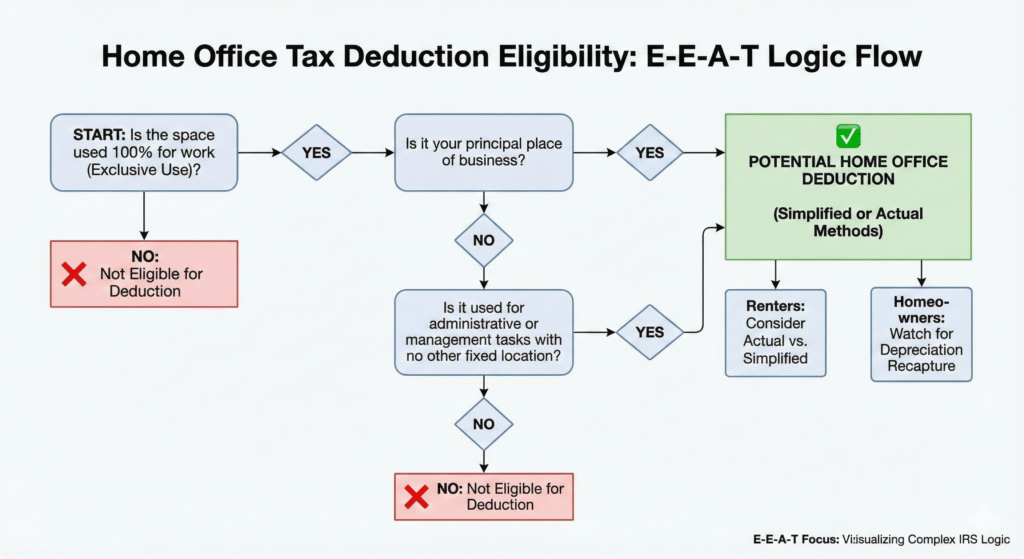
Here is the 500-word secret that high-priced CPAs know but the average freelancer misses: The “Exclusive Use” rule is the IRS’s favorite weapon, but it’s also your greatest shield.
Most people are terrified of the home office deduction because they’ve been told it’s an “audit trigger.” That was true in 1995. In 2026, with half the country working from their bedrooms, the IRS has bigger fish to fry provided you don’t hand them a reason to fine you. The secret is in the word “Exclusive.”
If you tell the IRS that your 200-square-foot office is used for business, but there’s a guest bed in the corner where your mother-in-law sleeps twice a year, you’ve technically violated the rule. If an auditor walks into that room (or, more likely in 2026, asks for a time-stamped photo or video tour), and they see a Peloton, a child’s toy box, or a TV that isn’t connected to your workstation, your entire deduction can be tossed out.
The Pro Secret: You don’t need a wall. The IRS used to require “a permanent partition,” but they lost that battle years ago. You just need a “separately identifiable space.” If you have a large studio apartment, use an area rug or a bookshelf to “zone” your office. Take a photo of it. That photo is your primary defense.
But here’s the real scoop: the IRS knows that most people are lazy with their “Gear” deductions (Section 179). Most freelancers just “depreciate” their computers over five years. That’s a sucker’s game. Under the One Big Beautiful Bill Act (OBBBA) of 2025, you can use 100% Bonus Depreciation or Section 179 to write off the entire cost of your gear in Year One.
If you buy a $4,000 workstation today, you don’t want a $800 deduction for the next five years. You want a $4,000 deduction now to offset your self-employment tax. The “secret” is that the IRS actually allows this, but tax software often defaults to the slower, “safer” depreciation method because it’s less likely to trigger a simple math-check flag. Don’t be “safe” be accurate. If you use that gear for business 100% of the time, take the full hit now. It’s your money; stop giving the government a zero-interest loan on your hardware.
A 2026 Case Study: How a Freelancer Saved $1,400 with a Closet Conversion
Let’s talk about Sarah. Sarah is a freelance graphic designer in Chicago. For three years, she worked from her dining room table. She didn’t claim a home office deduction because her “office” was also where she ate tacos on Tuesday nights. She was paying roughly $12,000 a year in self-employment taxes and felt like she was drowning.
Last year, Sarah got smart. She took a large walk-in closet in her two-bedroom apartment, took out the clothes racks, and installed a custom-built desk, two monitors, and soundproofing. She stopped using the dining table for work entirely.
The closet was only 40 square feet. On the “Simplified Method,” that’s only a $200 deduction ($40 x $5). Most people would stop there and say, “It’s not worth the effort.” But Sarah’s rent in Chicago is $2,800 a month. Her total home area is 800 square feet.
Her “Business Use Percentage” was:
40 / 800 = 5 %
Now, 5% doesn’t sound like much until you look at the total bill. Sarah’s annual rent, heat, electricity, and renter’s insurance totaled $38,000.
38,000 * 0.05 = $1,900
Then, she bought a high-end drawing tablet and a new iMac for $4,500. Following the “Inside Scoop” advice, she used Section 179 to claim the full amount in one year. Because she had a dedicated office space, the IRS didn’t question why she needed a $4,500 computer for her “home” business.
Total deduction: $1,900 (Office) + $4,500 (Gear) = $6,400.
By spending $0 on a new “office” (the closet was already there), she lowered her taxable income by $6,400. In her tax bracket, that put over $1,800 back in her pocket. Sarah used that money to upgrade her health insurance and finally hire a virtual assistant for two hours a week. She didn’t “cheat” the system; she just stopped letting the system cheat her.
Sarah’s “secret” wasn’t a magic loophole. It was the documentation. She kept a PDF of her lease, a copy of her utility bills, and most importantly a photo of that closet-office. If the IRS ever calls, she doesn’t have to scramble. She just hits “send” on an email. That peace of mind is worth more than the $1,800.
Critical Deduction Variables: Form 8829 and Principal Place of Business
If you’re going to play the game, you need to know the rules of the field. There are three variables that will make or break your deduction.
1. The “Principal Place of Business” Test
This is where people get tripped up. You might work at a client’s office three days a week, but if you do your billing, your admin work, and your “management” from your home office, and you have no other fixed location for those tasks, you pass. The 2026 Update: The IRS has become much more lenient about “hybrid” work for self-employed individuals, but they still hate it when you try to claim an office if you also rent a dedicated co-working desk. Pick one, or pro-rate both carefully.
2. Depreciation Recapture (The Homeowner’s Trap)
If you own your home and use the “Actual Expense” method, you must depreciate the business portion of your home’s value. The Catch: When you sell that house, the IRS will want that depreciation money back. It’s called “recapture.” This is why many homeowners prefer the Simplified Method it doesn’t require depreciation, so you don’t owe the IRS a “success tax” when you sell your home for a profit ten years from now.
3. The Gross Income Limitation
You can’t use a home office deduction to create a “business loss” to offset your W-2 income (if you have a side hustle). Your deduction is limited by the gross income of that specific business. If your freelance gig only made $1,000 this year, your home office deduction is capped at $1,000. You can, however, carry the leftover amount forward to next year.
Savings Comparison: High-Rent Cities vs. Suburban Deductions
| Variable | Simplified Method | Actual (Low Rent) | Actual (High Rent/City) |
| Office Size | 200 sq ft | 200 sq ft | 200 sq ft |
| Total Home Size | N/A | 2,000 sq ft | 1,000 sq ft |
| Annual Home Costs | N/A | $18,000 | $40,000 |
| Final Deduction | $1,000 | $1,800 | $8,000 |
Notice how moving from a suburban house to a city apartment (while keeping the office size the same) quadruples your deduction value.
State-Specific Variance: The Map of Complexity
- Florida & Texas: You’re in the “Green Zone.” With no state income tax, you only have to worry about the federal rules. This makes the “Actual Method” much more attractive because the paperwork is 50% lighter.
- California: CA is famously aggressive. They generally follow federal rules, but they have their own “independent contractor” tests (AB5) that might change how you file.
- New York: If you work in NYC, your “home office” percentage applies to that massive rent. NY state and city taxes are high, so every dollar you deduct on your federal return usually saves you an additional 10-12% on state/city filings.
FAQ: The Real-World Questions
Q: Can I deduct my kitchen table if I work there every morning? A: No. Unless you remove the chairs, the salt and pepper shakers, and never eat there, it fails the “Exclusive Use” test. Buy a $50 desk and stick it in a corner; that $50 investment could save you $500 in taxes.
Q: I work from a coffee shop three times a week. Can I deduct the lattes? A: Generally, no. That’s “meals,” not “office.” However, if you’re meeting a client there to discuss a contract, that’s a business meal (usually 50% deductible).
Q: Does my internet count as a home office expense? A: If you use the Actual Method, it’s part of your utilities. If you use the Simplified Method, it isn’t. However, you can often deduct your business-use percentage of the internet separately on Schedule C, regardless of which office method you choose.
External Resources
- IRS.gov: Look for Publication 587 (Business Use of Your Home). It’s dry, but it’s the law.
- ConsumerFinance.gov: Great for calculating the long-term impact of mortgage interest vs. tax deductions.
- Score.org: Offers free mentoring for small business owners on setting up proper bookkeeping.
Disclaimer: I am a financial researcher, not a licensed attorney or CPA. This tool provides estimates for educational purposes only. Always consult a professional before filing a legal claim.